
The Cockroach Generation.
What happens when 100,000 students raised in a Gen Z democracy movement land on campuses with a Gen Z democracy crisis? Australia is about to find out.


1. What happened at Jantar Mantar yesterday.
The Brief:
On Saturday 6 June 2026, hundreds of mostly young Indians gathered at Jantar Mantar in central New Delhi for the first organised street protest by the Cockroach Janta Party (CJP) — a satirical political movement formed exactly 3 weeks earlier, on 16 May, in response to remarks made the previous day by the Chief Justice of India, Surya Kant, in which he referred to India’s unemployed young people as “cockroaches” and “parasites of society”. By mid-afternoon, when the gathering wound up shortly after the movement’s founder, Abhijeet Dipke, began feeling unwell, the explicit demand on the table was the resignation, within 7 days, of central government Education Minister Dharmendra Pradhan over alleged irregularities in the NEET, CBSE, CUET and SSC qualifying examinations.
The strategy behind calling for the Education Minister’s resignation:
The leap from a Chief Justice’s slur to a demand for the Education Minister’s resignation is, on first reading, not obvious. The connection is structural and worth walking through, because it is the substantive argument the movement is making. The Chief Justice’s “cockroach” comment was directed at the cohort of unemployed graduates, which raises the immediate question of why that cohort is unemployed in the first place. Indian public discourse over the past two years has settled on a sharp answer: it is not the youth who have failed the system, it is the system that has failed the youth, and the most visible point of failure is the chain of examinations and recruitment tests that is supposed to translate education into work. The NEET-UG medical entrance was leaked in Patna in May 2024, with the Bihar police uncovering a racket in which aspirants had paid brokers an equivalent of between $45000-$75000 AUD for advance copies of the question paper, where 2.2 million students sat that exam, and several aspirants died by suicide in the aftermath. The same year, of fourteen competitive examinations conducted by the National Testing Agency, a parliamentary panel found that five had major issues; three had to be postponed. The CBSE on-screen evaluation process, the CUET university entrance exam, and the SSC-GD government recruitment exam have all surfaced their own irregularities. The cabinet minister responsible for every one of those examinations, and the political face of the system’s repeated failures, is the Union Education Minister Dharmendra Pradhan. The Indian National Congress has been demanding his resignation since June 2024. CJP is not inventing that demand. It is amplifying it and naming it as the most concrete, achievable answer to the Chief Justice’s insult: we are not parasites, the system is broken, and here is the person responsible for the part of it that is breaking us.
It is also, by design, tactically intelligent. The Chief Justice cannot be removed by street protest because the judiciary is independent. The Prime Minister cannot plausibly be forced out by a three-week-old movement. A cabinet minister can be made to resign through sustained political pressure. Pradhan is the achievable target, and an online petition that Dipke claims has been signed by more than 800,000 people gives the movement a measurable digital floor under what it is asking.

The Delhi Police deployed more than 1,000 personnel across the city. They detained 6 individuals at Jantar Mantar to prevent what they described as “a possible confrontation between two groups”. A separate CJP supporter, Jaidev Dagar, and several of his friends were intercepted and detained at Sampla Police Station, in Haryana, en route to Delhi. Dipke, who is 36 old, has lived in the United States for the past 2 years working in political communications, and whose family and friends had openly feared he might be arrested on landing in Delhi the previous evening — arrived early, urged supporters to maintain discipline, and led a peaceful rally. The protesters wore distributed cockroach masks. The most repeated slogan, on the live coverage I have read this morning, was “Cockroaches are coming, Dharmendra Pradhan is going.”
Under-estimating the street protest turnout:
The honest reading of yesterday is that the street turnout was visibly smaller than the online following suggested. CJP had, by the morning of the protest, accumulated more than 22 million Instagram followers, which is more than twice the following of the ruling Bharatiya Janata Party (BJP-Prime Minister Modi’s party). The crowd at Jantar Mantar was several thousand, generously counted and included media and spectators. The core of self-identified CJP supporters however, numbered in the hundreds to low thousands. That gap will be the story most of the Western and Indian centrist press tells about yesterday over the next 48 hours: the movement under-performed its own digital reach. That framing is not wrong on its own terms. But it is, I want to argue, the wrong frame for assessing what the movement actually is, and certainly the wrong frame for assessing what it means for Australia.
The Bangladesh student uprising that brought down Sheikh Hasina in 2024 began with protests of comparable initial size. The Nepal mobilisation that ended its government in five days in 2025 began with crowds in the hundreds. The history of every Gen Z protest in the 18-month Global South wave has been that the first organised street action is the proof-of-concept, not the climax. The Cockroach Janta Party is only 3 weeks old. It has now demonstrated that it can mobilise a peaceful, multi-city, mask-wearing street event under heavy police deployment, with a credible non-violent founder, a named ultimatum, and the public support of figures like Wangchuk. The next test — the 7-day Pradhan-resignation deadline — arrives on or around 13 June. The political class in New Delhi knows this, which is why a thousand police officers were on Delhi streets yesterday for a protest that turned out to be peaceful and small.
Bangladesh, Nepal, Kenya, Indonesia, Madagascar, the Philippines. Now India. Gen Z in the Global South is fighting for democracy at scale, and in many cases dying for it. Gen Z in the West is, on the polling, quietly giving up on it. The 100,000 Indian students in Australia are the only large cohort in the country that has been formed in the first political world and now lives in the second.
2. The Global South Gen Z wave, briefly catalogued.
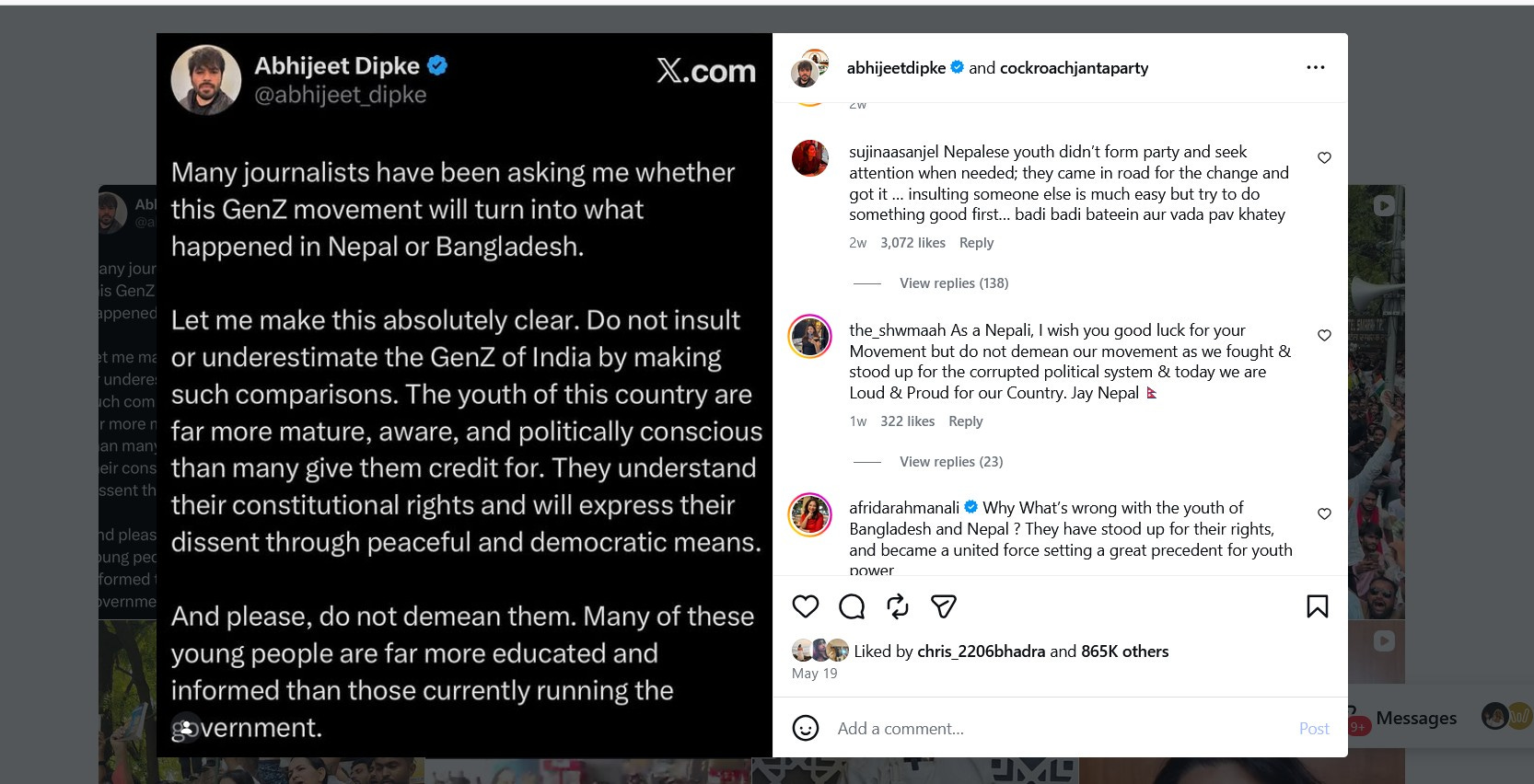
The Global South wave is now 18 months old.
It began in Bangladesh in mid-2024, when student protests over civil-service recruitment quotas escalated into a national anti-government movement that culminated, on 5 August 2024, in Prime Minister Sheikh Hasina’s resignation and escape to India after 15 years in power. Bangladesh is widely now described as the first successful Gen Z revolution in the world.
Kenya followed weeks later, with mass riots against the 2024 Finance Bill that became known internationally as the Gen Z protests against tax hikes and political corruption.
In 2025, Nepal compressed the entire cycle into 5 days: street demonstrations swept Kathmandu, police used live ammunition against unarmed students, more than seventy people were killed, hundreds were injured, and the government fell.
Indonesia followed almost immediately, with parliamentary housing-allowance scandals and rising costs of living triggering demonstrations that turned violent after a 21-year-old motorbike delivery driver, Affan Kurniawan, was killed by police.
Madagascar followed. The Philippines, Timor-Leste, the Maldives, Bulgaria.
Those movements share similiar tactics:
leaderless organising via X, TikTok, Instagram and Discord
rapid mass-turnout
refusal of traditional party structures
an iconography borrowed from popular culture — most strikingly the Straw Hats’ Jolly Roger flag from the Japanese anime One Piece, which has appeared at protests in Indonesia, Madagascar, Nepal and Bulgaria as an international symbol of the cohort.
They share demands that resolve, broadly, to the same 3 claims: accountability, dignity, and the right to a future the existing economic and political order is failing to provide. They have been triggered, in country after country, by what Amnesty International has documented as cost-of-living crises, perceived elite corruption, democratic backsliding, and shrinking economic possibility.
The Cockroach Janta Party, on yesterday’s evidence, is recognisably the Indian instance. It is using the same digital infrastructure, naming the same material grievances (40% graduate unemployment, the indignity of being publicly called parasites by the country’s most senior judge), organising in the same leaderless decentralised way, and pivoting from online to street politics on the same timeline.
What it has not done, on yesterday’s evidence, is reproduce the Bangladesh-scale mass turnout that would force immediate regime response. It is 3 weeks old after all. The wave it sits inside took 6 to 9 months to escalate in each of its previous instances. The relevant question is not whether yesterday matched the digital following. The relevant question is whether yesterday matches the early-stage profile of the previous Gen Z mobilisations the world has just watched. On that comparison, it does.
3. Meanwhile in the West, Gen Z is quietly disengaging from democracy.
The data on Western Gen Z attitudes toward democracy is now substantial enough to make a structural argument. I will summarise what I take to be the 4 most consequential findings, all from reputable sources published in the past 18 months.
The first is the CIRCLE / Tufts University survey, conducted with Protect Democracy. It found that 62% of US young people display what it terms “passive appreciation” of democracy: they trust democratic institutions and value democratic principles, but they do not actively engage. A further 31% display “dismissive detachment”: they do not buy into the value of democracy, have little confidence that the system works, show meaningfully higher support for authoritarian governments than other youth, rarely participate in political action, and believe they cannot create political change. Almost a third of US Gen Z, in other words, has stopped believing democracy is a project worth participating in.
The second is the Open Society Barometer global poll. Among respondents aged 18-35 worldwide, 35% were supportive of a strong leader who does away with legislatures and elections. Young people, the Open Society Foundations summary observes, “hold the least faith in democracy of any age group.”
The third is the More in Common / Democracy Group US polling, finding a substantial portion of Gen Z Americans skeptical of democracy and open to alternatives that would have been considered fringe in their parents’ generation.
The fourth is the MinnPost coverage of polling showing that 11% of US Gen Z believe political violence is sometimes necessary. That is not a fringe number. It is more than one in ten.
A useful distinction the Tufts research draws, and which most coverage has missed, is this: The 31% of young people who have given up on democracy are not the cohort most commentators assume. They are not the over-educated activist left being self-indulgent, and they are not the radicalised right-wing young men who dominate the news coverage of online extremism. They are the cohort with the lowest media literacy, the lowest educational attainment, and the lowest household incomes. The single best predictor of which young Westerner has stopped believing in democracy is not their race, not their gender, not their political ideology. It is whether they are struggling to pay rent. The people in the West who are giving up on democracy are the people the system has actually failed. They are also, demographically, the same young people who in Bangladesh and Nepal took to the streets and brought down governments. Same material conditions. Opposite political responses. That is the asymmetry this whole piece is trying to name.
Same material conditions, opposite political responses. The Global South Gen Z is mobilising toward democracy because they have lived under regimes where its absence was visible. The Western Gen Z is drifting from democracy because they have lived under regimes where its presence has not delivered. The asymmetry is the story and I will explain further below.
4. Why is one Gen Z fighting for democracy while the other is drifting from it?
This is the question that most coverage of the Global South Gen Z wave, and most coverage of Western democratic decline, treats as parallel rather than connected. I think the connection matters, and that 4 explanations are worth holding together rather than choosing among.
First, proximity to authoritarianism.
Bangladesh’s Gen Z watched 15 years of Sheikh Hasina’s consolidation of power, the arrests of opposition figures, the suppression of dissent.
Nepal’s Gen Z grew up after a monarchy and through repeated political instability.
Kenya’s Gen Z knows what state capture looks like because they can name the actors.
Let me explain what state capture is. State capture is a specific political-science term — it describes a situation where the institutions of the state (the treasury, the police, the procurement system, the regulators) have been quietly taken over by private interests (oligarchs, political families, corporate networks, sometimes foreign creditors). The state still goes through democratic motions — elections happen, parliament sits, courts rule — but the substantive decisions get made for the benefit of the captors, not the citizens.
In Kenya, a small number of political families have spent decades treating the government as a private business. Ordinary Kenyans pay taxes, and the money reliably ends up routed through contracts that benefit the same handful of names, generation after generation. Kenya's Gen Z grew up watching this happen, and when they took to the streets in 2024 against a punishing new tax bill, they could point to the specific families, the specific contracts, and the specific MPs who had voted to let it all continue. They were not protesting against an abstract idea. They were protesting against a list of names — names everyone in the country already knew.
Indian Gen Z has watched 12 years of BJP (Modi’s party) consolidation, the institutional capture of regulatory bodies and the press, the disciplining of universities. They know what they would lose if they lost democratic infrastructure because they have watched it being eroded in real time. Yesterday, when Dipke arrived in Delhi having spent the night before fearing arrest, was a precise illustration of that consciousness.
Western Gen Z, by contrast, grew up in countries that look like democracies on paper. The elections happen, the courts sit, the press is free. But from inside their own lives, none of that institutional machinery seems to do anything for them — wages have stalled, houses are out of reach, debts grow, the climate keeps getting worse. The democratic forms are working but the democratic outcomes are not. And because they have never had to live under a dictatorship — never seen elections cancelled, never seen a friend disappeared by the state — they have no felt reason to think democracy is precious. They have inherited something without ever being told what its absence costs.
Second, theory of change.
Bangladesh proved, on 5 August 2024, that mobilisation can produce regime change within a week.
Nepal proved it again.
The Global South Gen Z is operating on an updated theory of political possibility: street mobilisation works, social media multiplies it, leaderless organising survives suppression.
The Western Gen Z, by contrast, has watched Occupy, the Movement for Black Lives, the climate strikes, the post-Roe mobilisations (the protests across the United States after the Supreme Court overturned Roe v. Wade in 2022,), and the Hong Kong solidarity wave around the 2019 Hong Kong pro-democracy protests, which Beijing's 2020 National Security Law effectively crushed - all produce extraordinary energy and yet little durable structural change. Their theory of change is the inverse: mobilisation produces noise but not movement, system change is impossible from inside, and the rational response is exit — either into apolitical disengagement, or into the authoritarian alternative the polls now register.
Third, the role of economic insecurity.
The Global South Gen Z has 40% graduate unemployment, food-price inflation, and explicit political corruption to point at as the cause of their condition. The cause is legible.
Western Gen Z is in the same kind of trouble. They cannot afford housing because their parents’ generation bought when houses were cheap and the rules now protect that wealth. They carry student debt their parents did not. They work gig-economy jobs — Uber, freelance, contract — with no security. They face a climate future they did not cause and cannot stop.
The difference from Kenya, Bangladesh, or Nepal is not the size of the trouble. It is the shape of it. When a young Kenyan looks at their condition, they can name the specific families and contracts that are stealing from them. When a young Australian looks at the housing crisis, who do they name? The central bank? The local council? Their grandparents’ voting bloc? Negative gearing? Foreign investors? The honest answer is all of these and none of these. The cause is a system, not a person, and you cannot demand the resignation of a system. Anger with a clear target produces mobilisation. Anger with no clear target produces withdrawal — or, worse, vulnerability to politicians who will offer to invent a target for you. Think about how political parties in Australia are weaponising migrants and immigration.
Fourth, the algorithmic environment. Both cohorts live online and both are shaped by what their feeds serve them.
The Global South digital environment has, by necessity, retained a dense network of independent investigative journalism, vigorous opposition voices, and politically active diaspora media — which is how a movement built by a single political-communications professional in 3 weeks reaches 22 million Instagram followers and turns out the first protest a week ahead of its founder’s scheduled arrival.
The Western digital environment looks very different. The serious independent journalism that used to anchor political conversation has been hollowed out — newspapers closing, foreign correspondents pulled, local reporting gutted. What has replaced it is a feed-based environment run by social media platforms whose only business model is keeping you scrolling. Their algorithms reward whatever holds your attention longest, and the single most reliable thing that holds your attention is anger. The result is a stream of content that makes young Westerners furious about politics, culture, the news, each other — but never connects that fury to actual organising, to a named demand, to a person who could be pressured to change. The anger gets monetised on the way past and it does not get translated into anything you could do about it.
The Tufts research connects this directly to the disengagement data: the young people most disengaged from democracy are also the young people least able to tell reliable information from unreliable, and those are the same young people whose information environment has been most thoroughly shaped by the algorithmic feeds. That is not a coincidence. The algorithmic environment is part of what produces the disengagement.
I am, with these 4 explanations, deliberately not collapsing the asymmetry into a single cause. The point is that they reinforce one another, and that they explain a structural divergence in Gen Z political identity that the Australian political class is not, as far as I can tell, even aware of.
5. The 100,000 Indian students in Australia are the collision point.
There are about 100,000 Indian students studying in Australia, accounting for approximately 16% of all international enrolments. They live, study, and form their political identities on the same campuses as Australian Gen Z students. They arrive having been formed in a political culture in which democracy is a contested, urgent, materially consequential project — a culture that has just produced, in 3 weeks, the largest digital youth political movement in Indian history and held its first street test on a Delhi square yesterday afternoon under heavy police presence. They live, on those Australian campuses, alongside Australian Gen Z students whose own polling tells a very different story. Roughly 1 in 3 of those Australian students have stopped believing democracy can deliver for them. They do not participate. They are measurably more open than other young people to the idea of a strong leader without elections. The classmates these Indian students are now meeting are not the politically formed cohort they were studying alongside back home.
The political-formation collision this produces is not theoretical. It is happening, right now, on every campus. The questions it raises are these: do the Indian students, on contact with their Australian peers, absorb the local disengagement and become, themselves, less politically active than they would have been at home? Or do the Australian students, on contact with their Indian peers, become re-energised by the example of a Gen Z that still believes in democratic possibility? Or, more plausibly than either single direction, do both processes happen at once, producing a chaotic, under-analysed, deeply consequential redrawing of Australian campus political culture? The honest answer, today, is that we do not know, because nobody is asking.
In March 2026, the Indian Overseas Youth Congress Australia (IOYCA) opened its first office in Sydney, with an emerging network of approximately 500 members across major Australian cities. That is a beginning. It is not yet the response the moment requires. The IOYCA is affiliated with the Indian National Congress — which means that, by the political logic of the current Indian moment, it is broadly aligned against the BJP and tonally adjacent to (though not identical with) the constituency CJP is building. It has a structural relationship to the political formation the Cockroach Janta Party is now disrupting. What it does not yet have, and what nobody in Australia is yet building, is an infrastructure for the political conversation between Indian Gen Z formed in the CJP moment and Australian Gen Z formed in the dismissive-detachment moment.
This matters for a series of concrete Australian outcomes. The 100,000 Indian students are now a political constituency in their own right — not a service-delivery population, not a visa-policy file, not a multicultural-engagement checkbox. They are young people who, on the data, are arriving with a more vigorous democratic instinct than the host society’s own youth cohort is showing.
The Australian political class has spent 2 decades thinking about Indian students primarily as a higher-education export industry. It has not spent any meaningful time thinking about them as a potential political resource for the renewal of Australian democratic culture itself.
6. Gap analysis — what Australian universities, political parties, and civil society need to learn.
There are 3 gaps in the current Australian conversation, and naming them is what this piece is meant to do.
The first gap is in the universities. Australian universities have, since the 2009 attacks on Indian students in Melbourne, treated their Indian student cohort principally through the lens of safety, wellbeing, and international-education revenue. The political-formation collision now unfolding on their campuses has not been the subject of formal institutional attention. There is no major Australian university that I am aware of that has, in 2026, produced research, policy work, or programming explicitly addressing what the Global South Gen Z mobilisation means for its own student political culture. There are excellent individual academics doing related work — migration studies, diaspora studies, comparative political mobilisation — but the institutional layer is silent. That silence is a missed opportunity. The Indian Gen Z arriving on Australian campuses in 2026 has been formed in one of the most politically generative moments of the last 50 years, and the universities they are paying tens of thousands of dollars a year to attend have not noticed.
The second gap is in the political parties. Both major Australian parties continue to engage with Indian-Australian students through the lens of visa pathways, work-rights, and post-study migration. That engagement is materially important and should continue. It is not, however, a political engagement. A political engagement would treat the cohort as voters-in-formation, citizens-in-formation, civic actors with their own theories of democratic possibility, and would build engagement infrastructure that meets them at that level. The Labor Party’s 2025 federal engagement strategy for Indian-Australian voters did not, as far as I can tell from public materials, even acknowledge the Global South Gen Z wave that had already produced a regime change in Bangladesh. The Coalition’s strategy was similar in shape. Both parties are about to learn that the cohort they have been treating as a labour-market issue has, in the past 18 months, become one of the most politically formed youth populations on earth. I would like to take a moment to acknowledge that this has been the crux of our work at Allies in Colour and COMPELL.
The third gap is in civil society, including in the multicultural peak-body sector I work in. We have, collectively, been better at responding to defensive moments (the rise of anti-immigration politics, the One Nation breakthrough in Farrer last month, the Trumpian rhetoric being imported into the Coalition’s “subversive intent” framing) than at responding to generative ones. The Global South Gen Z wave is a generative moment. It is happening at the door of the Australian peak-body sector and is mostly not being engaged. The diaspora media in Australia — The Indian Sun, Indian Link, SBS Hindi, Neos Kosmos, the various Tamil and Punjabi and Bengali language publications — is, in patches, covering CJP and the Indian moment. The peak bodies are not yet treating it as a political event with domestic Australian consequences. We should be and as CEO of Allies in Colour, I certainly have been.
The Cockroach Generation is not a phenomenon Australia is observing from a safe distance. It is a phenomenon Australia is hosting, on every university campus from Sydney to Perth, in real time, with no institutional response in place. That is the gap, and it is closing whether we engage or not.
7. What follows.
The 7-day ultimatum that CJP delivered to the Modi government yesterday afternoon expires on or around 13 June. By the time you (thoroughly) read this, we will know whether Dharmendra Pradhan has resigned (extraordinarily unlikely), whether the movement has called a second, larger protest (likely), whether the police response has escalated from confrontation-prevention detentions to mass arrests (possible), and whether Dipke is still in the country (uncertain — he is now back in India for the first time in 2 years and was clear before his arrival that his family feared arrest). Whatever happens on or around 13 June, the structural conditions that produced the movement are not going away. India’s graduate unemployment will still be at 40%. India’s 12 year drift toward Hindu nationalism will still be the dominant political environment. The 22 million Instagram followers will still be there, and will still be available to be mobilised for the next moment, and the moment after that, and the moment after that.
The Australian conversation about Indian-Australian students and the broader Indian diaspora has, until now, been conducted in a fundamentally provincial register. We have asked what migration policy should be, what visa caps should be, what the economic value of international education is, what the multicultural engagement strategy should be. We have not asked what kind of political subjects the students themselves are. We have not noticed that they are, on the data, arriving with a more vigorous democratic instinct than our own youth cohort is showing on average. We have not built the institutional response that this moment requires.
The work, then, is in 3 places. Australian universities should formally engage with the political-formation experience their international students bring — not as a research curiosity, but as a contribution to the democratic culture of the institutions themselves. Australian political parties should treat the 100,000 Indian students as politically formed agents whose engagement now will shape Australian democratic culture in the decade ahead. And Australian civil society, including the peak-body sector, should build the spaces in which the Cockroach Generation’s political experience can meet, learn from, and re-energise the Australian Gen Z cohort whose disengagement from democracy is now well documented and, if we choose to leave it unaddressed, structurally durable.
India’s Chief Justice called India’s young people cockroaches. They made it the name of their movement, built it into the largest digital political party in their country’s history in 3 weeks, and yesterday they held their first street test on a Delhi square under heavy police deployment without a single act of violence on the protesters’ side. There is a political lesson in that response that has nothing to do with India and everything to do with what democratic culture looks like when it is in good working order. Australian democratic culture, on the available data, is not in good working order. The cohort best positioned to repair it is sitting in our lecture theatres right now. Whether we are honest enough to recognise that and to act on it before the next street test in Delhi on or around 13 June, is the only question that matters in this story for us.
Tharini Rouwette is CEO of Allies in Colour, an independent multicultural peak body, and of COMPELL.